
Know exactly what you’re buying.
Seven parts do all of the work. Open a real automatic transfer switch in your browser, take the door off, pull it apart, and find out what every piece does — before you put it on a purchase order.
Explore the switchAutomatic transfer switches · explained plainly
An automatic transfer switch — an ATS — is a self-acting electrical device that moves a building’s critical loads from their normal power source to a backup source, usually a generator, the moment normal power becomes unacceptable. It moves them back when normal power returns. It switches the load, not the power.
The essential job
A generator on its own does nothing for you. Something has to notice that the utility has failed, start the engine, wait until the generator is actually producing usable power, and only then hand the building over — without ever letting both sources touch each other. That job is the transfer switch.
Why “automatic” is the whole point. A manual transfer switch does the same electrical work, but it waits for a human with a flashlight. An ATS does it in seconds, at 3 a.m., on a holiday, with nobody in the building. For a hospital, a data center, or a wastewater plant, that difference is the entire reason the device exists.
Timing
People assume the dark stretch after an outage is the switch making up its mind. It isn’t. Almost all of it is the engine.
The switch is the fast part. On an open-transition unit the contacts move in a fraction of a second — the reason your lights are out for ten is that a diesel has to crank, catch, and come up to acceptable voltage and frequency first. That is also why a closed-transition switch only helps you on the way back: it can overlap the two sources when both are already alive and healthy, so returning to utility power costs the building no interruption at all.
The number that governs everything
For a Level 1 emergency system — the kind that keeps operating-room lights and egress lighting alive — code requires backup power to be carrying the load within ten seconds of losing the utility. Every timer, contact and control decision inside the switch exists to make that number.
The sequence
Every automatic transfer switch on the market runs some version of these six steps. The brands differ in how the contacts are built and how much you can adjust; the sequence does not.
The controller watches voltage and frequency on the normal source continuously. A sag, a phase loss, or a complete outage all count — it is looking for power that is unacceptable, not merely absent.
A short, adjustable delay rides through momentary dips so a passing cloud on the grid doesn’t start a diesel. Typically a second or two.
The switch closes the engine-start contacts. This is the only wire between the switch and the generator that matters, and it is why the ATS — not the generator — is what actually runs a standby system.
The controller will not transfer to a source it doesn’t trust. It holds until the generator reaches acceptable voltage and frequency — handing a hospital to a half-started engine is worse than the outage.
The mechanism opens the utility side and closes the generator side onto the same load busbar. A mechanical interlock makes it physically impossible for both to be closed at once on an open-transition unit.
When utility power comes back and stays back for the retransfer delay — usually minutes, not seconds — the load goes home. The engine then runs unloaded to cool before it shuts off.
Anatomy
Seven parts do all of the work. Drag to turn the unit, open the door, or pull it apart — then click any part to find out what it does.
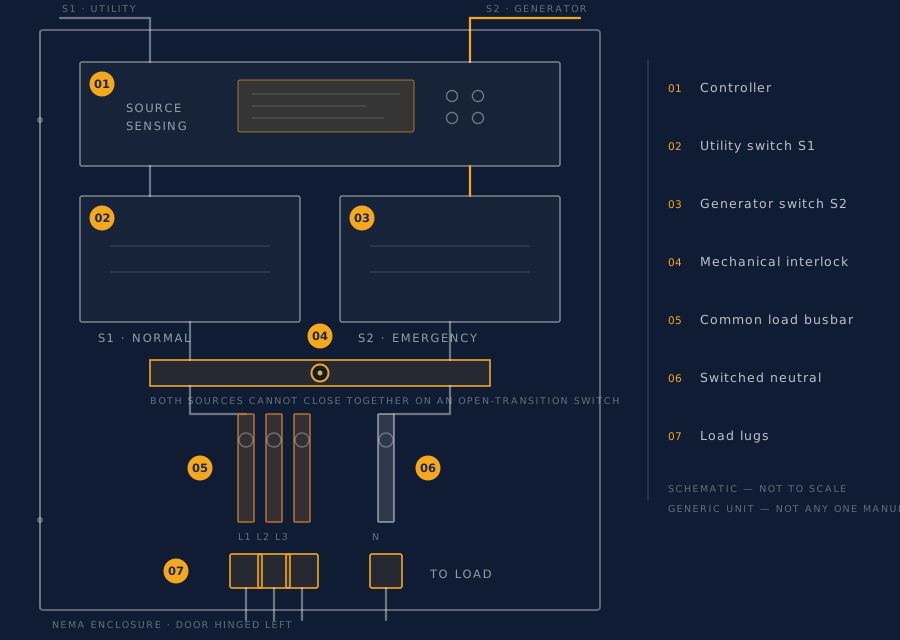
Watches both sources continuously. It decides whether utility power has genuinely failed or merely dipped, then runs the timing — transfer delay, retransfer delay, engine warm-up and cooldown — so the load isn’t thrown back and forth on a momentary sag.
Generic contactor/breaker-type unit, shown schematically. Not a scale replica of any manufacturer’s product.
Types
The first three describe how the switch moves the load. The last three describe what else the unit is asked to do. A real spec usually names one from each group.
Break-before-make. The load is disconnected from one source before it is connected to the other, so there is a brief interruption. The default, and correct for the large majority of standby systems.
Make-before-break. When both sources are alive and in sync, the switch overlaps them for a fraction of a second so the load never sees a break. Requires utility coordination — you are briefly paralleled to the grid.
Deliberately pauses in the neutral position for an adjustable interval. Used where large motor loads would otherwise be re-energised out of phase and damage themselves. Sometimes called programmed neutral.
A second set of switching allows the transfer switch to be bypassed and physically withdrawn while the load keeps running. If the facility cannot be shut down to service the ATS, this is what makes maintenance possible.
Carries the required overcurrent protection and a means of disconnect, so it can be the first device after the utility. Saves a separate service disconnect — but it is a code question, not a preference.
A fourth pole that transfers the neutral along with the phases. Required where each source is separately derived and you cannot have two grounded neutral paths creating circulating current.
Automatic vs manual
A manual transfer switch is not a lesser product — for a shop or a house with somebody home, it is often the right call. The difference is what happens when nobody is there.
Specifying
Sizing an ATS is not the same as sizing a generator. The switch is rated for the load it carries, not the kilowatts the engine makes — and half the quoting delays in this industry come from a spec missing one of these lines.
The one people forget is the withstand and close-on rating. An ATS that is correct on amps but under-rated on available fault current is not a cheaper option — it is a unit that cannot legally be installed, and the inspector will find it.
Codes and standards
Three documents decide almost every argument about a transfer switch in the United States. If you are specifying, buying, or inspecting one, these are the reference points.
UL 1008 is the safety standard the switch itself is listed to. A transfer switch used in an emergency or legally required standby system has to carry it, and the listing is what the withstand and close-on ratings are established under.
NEC Articles 700, 701 and 702 divide standby systems into three classes — emergency (700), legally required standby (701), and optional standby (702). Which one your load falls under changes the required transfer time, the wiring separation, and the testing regime. It is the first question a designer should ask and the one most often skipped.
NFPA 110 classifies emergency power supply systems by how long they must run and how fast they must pick up. Type 10 — power within ten seconds — is the one that governs life-safety loads, and it is where the ten-second figure at the top of this page comes from.
Where to start
Seven parts do all of the work. Open a real automatic transfer switch in your browser, take the door off, pull it apart, and find out what every piece does — before you put it on a purchase order.
Explore the switchThe switch your project is waiting on has usually already been built. We work six sourcing channels most buyers never see — cancelled orders, decommissioned plants, surplus, reconditioning — and come back inside a day.
How we find itBrand, amperage, poles and voltage — or just a photo of the plate on a unit that has already failed. You get a straight answer within 24 hours, including a fast no if we can’t get it.
Start a sourcing requestQuestions we actually get
If the generator has to start without a person present, yes. A generator with no transfer switch has no safe, code-compliant way to pick up the building — and back-feeding a panel any other way puts lethal voltage on utility lines that a lineman believes are dead. For life-safety loads under NEC 700, an automatic switch is not optional.
Size it to the load it will carry, not to the generator’s kilowatt rating. Work from the continuous amperage of the circuits being transferred, then confirm the voltage, phase, pole count, and the available fault current at that point in the system. A switch that is correct on amps but under-rated on withstand current cannot be installed.
They do the same electrical work — move the load from one source to another without letting the two touch. A manual switch waits for a person to operate it. An automatic switch senses the failure, starts the generator, and transfers on its own, typically within ten seconds. Life-safety loads require automatic operation.
There is no single answer, and anyone quoting one before seeing your spec is guessing. Price is driven by amperage, voltage class, transition type, enclosure, whether bypass-isolation is required, and whether the unit is new, surplus, or reconditioned. A small residential-class switch and a 3000 A bypass-isolation unit are different products by orders of magnitude.
No. This is licensed-electrician work under permit and inspection. The switch sits between the utility service and the building’s distribution, which means energised service conductors, fault-current calculations, grounding and bonding decisions, and in most jurisdictions coordination with the utility before it is energised.
The enclosure and busbar outlive most buildings. What wears is the switching mechanism and the controller — contacts have a rated number of operations, and older solid-state controllers eventually become the part nobody stocks. Well-maintained units routinely run decades, which is exactly why a tested, reconditioned switch is a real option rather than a compromise.
If you’re here because one failed
Most people reading this page are specifying a switch. Some are standing in front of a dead one. If that’s you: brand, amperage, poles and voltage — or just a photo of the nameplate — and you’ll have a straight answer inside a day, including a fast no if we can’t get it. And if it turns out the generator is the part you’re actually short of, we source those too.